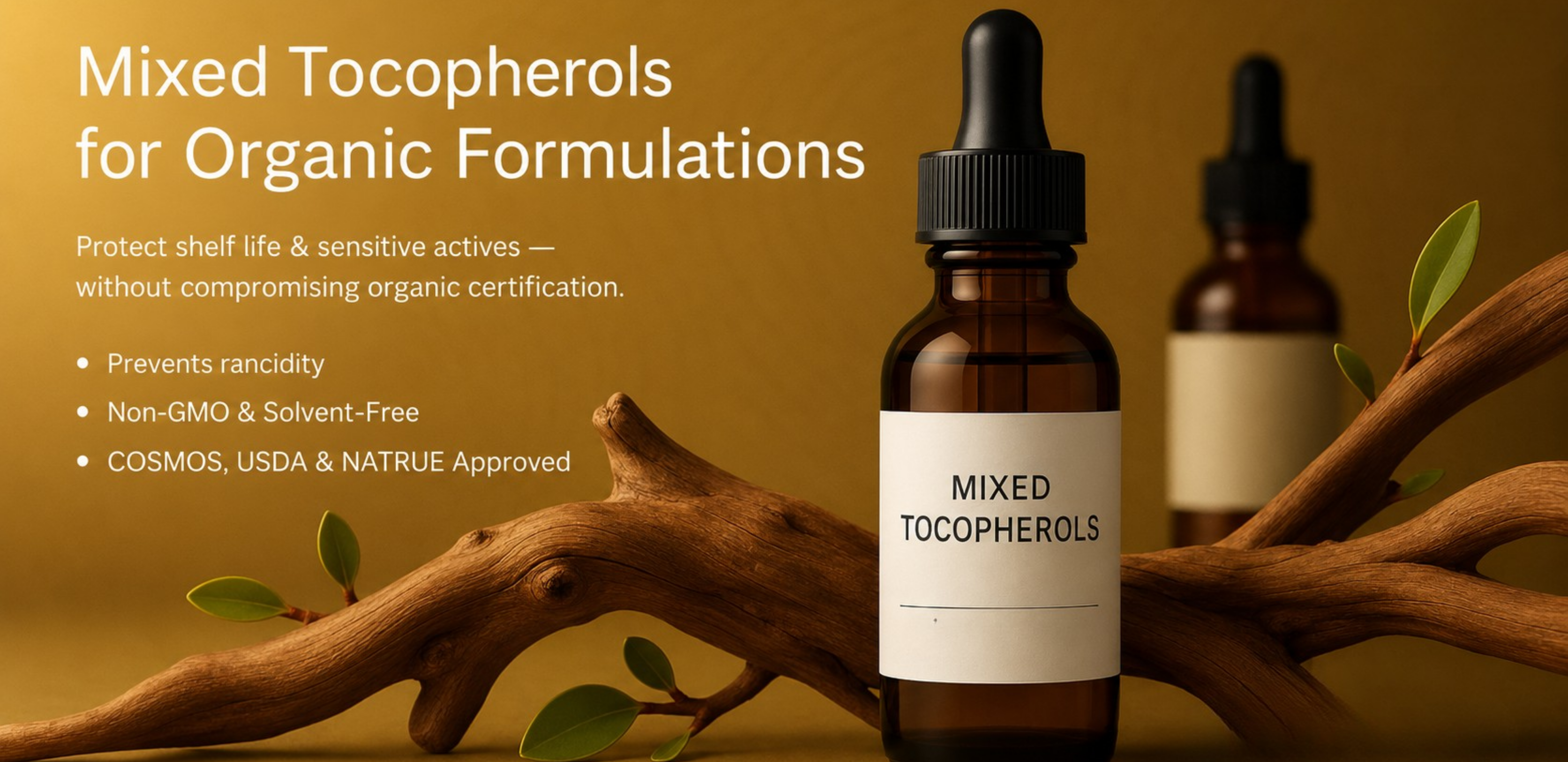
Mixed Tocopherols in Organic Formulations: What Certifiers Allow
Vitamin E is widely used in clean-label food, cosmetic, nutraceutical, and personal-care formulations. However, when it comes to organic certification, not every naturally derived tocopherol ingredient is treated in the same way.
For manufacturers and formulators, selecting a reliable Mixed Tocopherols Supplier in India is essential for maintaining formulation stability, regulatory compliance, ingredient traceability, and organic product integrity.
What Are Mixed Tocopherols?
Mixed tocopherols are a naturally derived combination of alpha-, beta-, gamma-, and delta-tocopherol isomers. They are commonly obtained from vegetable oils such as sunflower, soybean, or rapeseed oil.
In formulations, mixed tocopherols primarily function as lipid-soluble antioxidants. They help slow down oxidation, prevent rancidity, protect sensitive ingredients, and support the shelf-life stability of oils, emulsions, supplements, and food products.
However, naturally sourced does not automatically mean certified organic. The agricultural source, processing method, carrier oil, solvent system, concentration, and supporting documentation can all influence whether the ingredient is accepted by an organic certifier.
What Do Organic Certifiers Allow?
Organic regulations may permit a limited percentage of approved non-organic ingredients in certified organic products when an appropriate organic alternative is unavailable. These ingredients must comply with the applicable sourcing, processing, functional-use, and documentation requirements.
Tocopherol-rich extract, commonly identified as E306 in food applications, may be accepted as an antioxidant when it meets the relevant certification conditions.
Depending on the certifier and intended application, the mixed tocopherol ingredient may need to be naturally derived, sourced from non-GMO vegetable oils, manufactured using permitted processing methods, and used only at the minimum technically necessary concentration.
For cosmetic formulations, certification standards such as COSMOS, Ecocert, and NATRUE may accept certain mixed tocopherol ingredients when their origin, processing method, carrier system, and documentation comply with the applicable standard.
Mixed tocopherols standardised in sunflower oil are frequently considered by formulators seeking a non-GMO and clean-label antioxidant solution. Final acceptance, however, must always be confirmed with the relevant certification body.
Mixed Tocopherols in Cosmetic Formulations
Mixed tocopherols are widely incorporated into facial oils, creams, lotions, serums, balms, hair oils, massage oils, and other lipid-based personal-care products.
They can help stabilise plant oils and emulsions, protect oxidation-sensitive actives, support product shelf life, and reduce undesirable changes in colour, aroma, and texture.
Mixed tocopherols may also contribute to the skin-conditioning profile of a cosmetic formulation. However, formulation claims must remain consistent with the ingredient concentration, product testing, and applicable cosmetic regulations.
A dependable Mixed Tocopherols Supplier in India should provide detailed information about the botanical source, tocopherol composition, carrier oil, non-GMO status, processing method, recommended dosage, and certification compatibility.
Mixed Tocopherols in Food Applications
In food and nutritional formulations, mixed tocopherols are commonly used to protect oxidation-sensitive fats and oils.
Applications may include edible oils, bakery products, snacks, dressings, nutrition bars, dietary supplements, plant-based products, and functional food formulations.
Mixed tocopherols can help delay lipid oxidation, maintain flavour quality, protect sensitive nutrients, and support product shelf-life performance.
The required concentration depends on the fat composition, processing conditions, packaging system, storage environment, and expected shelf life of the finished product.
Documentation Required for Organic Audits
Formulators should maintain complete technical and regulatory documentation for mixed tocopherol ingredients used in certified organic products.
Relevant documentation may include:
- Certificate of Analysis
- Technical Data Sheet
- Safety Data Sheet
- Non-GMO declaration
- Allergen declaration
- Source-oil information
- Processing-method declaration
- Organic or natural-standard documentation
- Recommended usage level
- Ingredient composition and carrier details
- Traceability and batch records
The ingredient name, source, concentration, and technical function should also be clearly documented within the formulation and certification records.
Why Ingredient Selection Matters
Consumers expect organic labels to represent transparency, responsible sourcing, controlled processing, and credible certification. Using an unsuitable or insufficiently documented tocopherol ingredient may create certification complications, audit observations, reformulation costs, or labelling risks.
Selecting the right mixed tocopherol solution is therefore not only about preventing oxidation. It also supports regulatory confidence, formulation consistency, product quality, and long-term brand credibility.
Manufacturers searching for a Mixed Tocopherols Supplier in India should evaluate more than antioxidant strength. They should also consider ingredient origin, tocopherol profile, carrier oil, regulatory documentation, non-GMO status, processing method, application suitability, and certifier acceptance.
The final eligibility of any mixed tocopherol ingredient should be confirmed with the relevant organic certification body before commercial production or certification submission.
FAQs
Mixed tocopherols are naturally derived forms of Vitamin E, typically containing alpha-, beta-, gamma-, and delta-tocopherols. They are commonly sourced from vegetable oils such as sunflower, soybean, or rapeseed oil.
Mixed tocopherols are mainly used as lipid-soluble antioxidants. They help slow oxidation, reduce rancidity, protect sensitive ingredients, and improve the shelf-life stability of oils, foods, supplements, and cosmetic formulations.
No. Natural origin does not automatically mean certified organic. The agricultural source, processing method, carrier oil, solvents, concentration, and supporting documentation can affect certification eligibility.
Mixed tocopherols are commonly incorporated into facial oils, creams, lotions, serums, balms, hair oils, massage oils, and other lipid-based personal-care products to improve oxidative stability.